

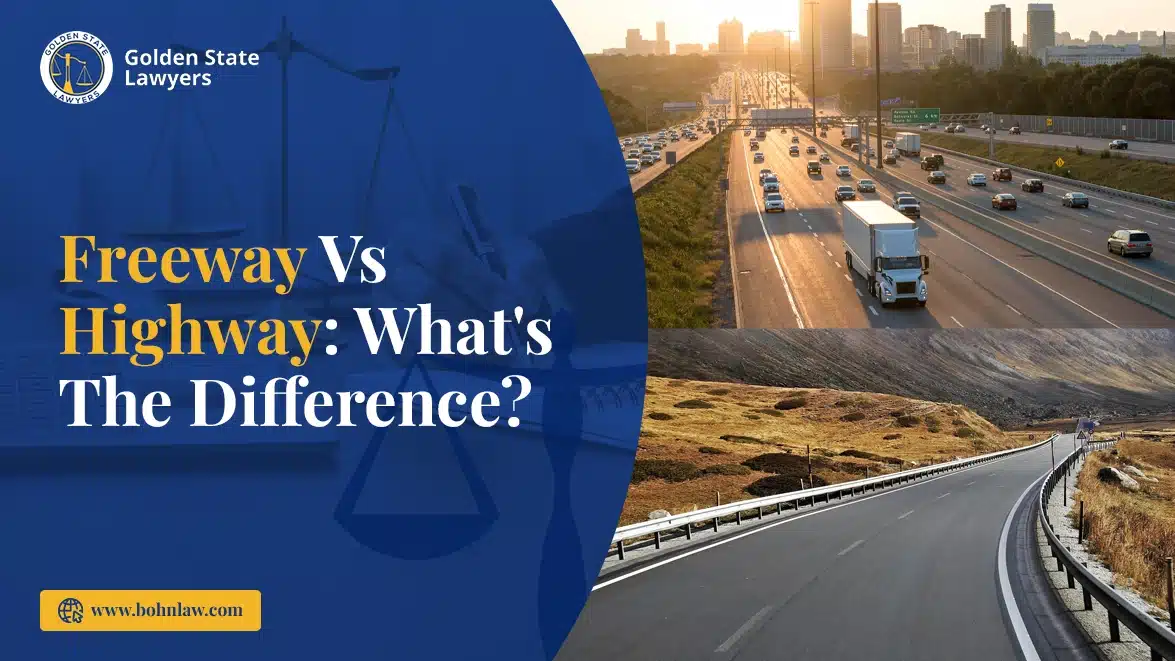
Have you ever been driving and suddenly realized… you’re not actually sure what kind of road you’re on? One sign says “Freeway Entrance,” another says “Highway,” and everyone around you just uses both words like they mean the same thing. But they don’t. And the difference between highway and freeway matters a lot. Especially once you think about speed, traffic flow, and what happens when a crash occurs.
A freeway is built for nonstop movement, ramps in, ramps out, fast lanes, no lights. A highway is looser, mixed, part fast, part local, with intersections, turns, and everyday traffic cutting across.
What Is a Freeway?
A freeway is a specific type of highway designed for controlled access. It’s meant to keep you flowing. No stopping, no random cross streets, no sudden red lights. Everything about a freeway is engineered for speed, consistency, and long stretches of predictable driving.
What defines a freeway:
- Fully controlled access through on-ramps and off-ramps
- Higher speed limits, usually 55–70 mph in California
- No traffic lights or stop signs
- No cross traffic cutting across the lanes
- No pedestrians, cyclists, or local driveways
- Barriers or medians separating traffic directions
- Multiple lanes designed for passing and merging
Freeways often feel safer because of their structure but the risks are different. Fast speeds mean any collision can become severe quickly, especially rear-end impacts, sideswipes during merging, or crashes caused by sudden lane changes.
Common accident types on freeways:
- High-speed rear-end collisions
- Lane-change crashes during congestion
- Multi-vehicle pileups during heavy traffic
- Wrong-way driver accidents (rare but often deadly)
- Speed-related loss of control
Freeways eliminate many hazards, but the ones that remain usually happen at higher speeds, which is why injuries tend to be more serious.
What Is a Highway?
Highways are more flexible, more accessible, and more varied. They can feel like fast-moving major roads in one area and small-town streets in the next. Highways connect everything like local neighborhoods, rural stretches, business areas, and long-distance routes.
What defines a highway:
- Not always controlled-access (driveways and cross streets allowed)
- Possible traffic signals and stop signs
- Left turns, right turns, and merging across lanes
- Speed limits that change frequently
- Pedestrian and bicycle access in some areas
- Businesses, homes, and parking lot entrances
Because highways sit closer to daily life, groceries, gas stations, neighborhoods, they come with more unpredictability.
Common accident types on highways:
- Intersection collisions
- Left-turn crashes
- Sudden-stop rear-end accidents
- Pedestrian or cyclist impacts
- Turning or crossing-traffic collisions
- Parking-lot entrance/exit crashes
Highways carry more “human unpredictability,” which can make them more prone to frequent collisions at lower speeds.
Differences between Freeway and Highway
This is where the real separation becomes obvious. Freeways and highways serve different purposes, have different designs, and create different driving environments.
| Feature | Freeway | Highway |
| Access | Controlled; only ramps | Open; driveways, lights, intersections |
| Traffic Flow | Continuous, no stopping | Frequently interrupted |
| Speed | Higher, consistent | Varies widely by area |
| Pedestrian/Bike Access | Not allowed | Allowed in some locations |
| Environment | Limited access, few distractions | Businesses, homes, roadside activity |
| Safety Risks | High-speed crashes | Turning/merging conflicts |
| Purpose | Fast long-distance travel | Local + regional travel |
Here’s Why These Differences Matter
Knowing the difference between a highway and a freeway helps make sense of what actually happens on the road. Each one creates its own kind of driving environment, and that changes everything about how accidents happen, how severe they are, and how fault gets sorted out afterward.
- The risks aren’t the same: Freeways cut out the usual trouble spots. Highways add in lights, turns, and cross-traffic that create more chances for things to go wrong.
- Speed shapes the outcome: Freeways see fewer conflicts but harder impacts. Highways see more conflicts, just at lower speeds.
- Drivers behave differently: On a freeway, people expect a steady flow. On a highway, they expect stops, surprises, and slower traffic weaving in and out.
- Fault gets judged through design: A freeway crash might involve speeding or lane changes. A highway crash might be about right-of-way or someone turning too early.
Those small structural differences end up shaping the entire story of a collision.
Conclusion
Once you understand the basics, the difference between highway and freeway becomes clearer than ever. A freeway is built for speed, ramps only, no traffic lights, no cross streets, no pedestrians slowing things down. A highway is more open, more flexible, and more unpredictable, with intersections, signals, and everyday traffic weaving in and out.
Those structural differences shape everything: how drivers behave, how accidents happen, how severe those accidents become, and even how responsibility is determined afterward. Knowing whether you were on a freeway or a highway helps make sense of the conditions leading up to a collision.
And if you’re sorting through the aftermath of a crash on either type of road, Golden State Lawyers can guide you through your next steps.